Your Coach Notes
Gathered from across the programme
This workspace collects everything you've written in the Coach Notes sections throughout the programme. Return here any time to review your journey, prepare for a mentoring call, or remind yourself of insights from earlier in the training.
Unlock Your Next Lesson
Enter the code Alan sent you to continue
Enter your access code
When you're ready for the next part of the programme, Alan will send you an access code by email. Enter it here and your next lesson will unlock immediately.
Orientation
Before You Begin
This brief orientation video welcomes you to the HeartMath Coach / Mentor Certification Programme and sets the context for what lies ahead. The programme is designed to be experienced sequentially — each lesson building on the one before. At the same time, this is not a race. The practices you'll encounter are meant to be lived, not just learned.
Before You Continue
Take a moment to set an intention for this training. Why are you here? What do you want to develop — not just in skill, but in how you show up as a coach?
Your personal notes and reflections. Saved automatically and gathered in My Workspace.
The Inner Journey Begins
Video 1 of 6
Personal Before Professional
This first video marks the starting point of the HeartMath Coach / Mentor journey. Before learning techniques, models, or coaching applications, it invites you into the most important part — your own experience. HeartMath is not something you apply to others first. It's something you live.
In this video, you'll be invited to identify an area of your life that currently drains your energy, notice how stress shows up mentally, emotionally, and physically, begin developing awareness of your personal stress patterns, and understand why self-awareness is the gateway to self-regulation.
A core principle from the outset
You cannot guide others into territory you have not explored yourself. This training begins with you — honestly, without performance.
What's Happening Beneath the Surface
Video 2 of 6
Understanding Stress, Energy, and Resilience
In the first video, you turned toward your own experience — noticing where stress shows up and how it affects your energy. In this second video, we step back to understand what's actually happening beneath the surface when stress arises — and why self-regulation works. This video introduces the HeartMath Resilience Model, which looks at resilience across four interconnected domains: Mental (attention, focus, and flexibility), Physical (capacity, endurance, and balance), Emotional (self-regulation, emotional flexibility, and outlook), and Spiritual (meaning, purpose, and connection).
Something worth sitting with
Stress shows up across all four domains simultaneously. Coherence-building practices restore balance across the whole system — not just the mind.
Awareness of Patterns
Video 3 of 6
How Your Inner State Shapes What You Experience
This video invites you to become aware of how your thoughts influence your emotional state, how your emotional state affects your body, and how your internal "soundtrack" shapes how you interpret situations. Most stress doesn't come from single events — it comes from repeated interpretations and familiar inner reactions. When these patterns remain unconscious, they drain energy automatically and limit choice. When they're seen clearly, something shifts. Awareness creates space.
Key observations
- We don't just experience situations — we interpret them
- Emotional states influence perception
- Awareness interrupts automatic stress patterns
Work through the exercise directly here, or use it alongside the downloadable worksheet.
Heart-Focused Breathing™
Video 4 of 6
Creating the Space Between Stimulus and Response
Up to this point, the focus has been on awareness. In this video, you begin your first active self-regulation practice. Heart-Focused Breathing (HFB) is the foundational HeartMath technique — it creates the physiological conditions needed for coherence and emotional self-regulation.
The Core Steps
- Shift your attention to the area of your heart. You may place a hand on your chest if it helps.
- Breathe a little slower and deeper than usual, imagining the breath flowing in and out of the heart area. Allow the breath to be comfortable and unforced. Optional rhythm: inhale for a count of 5, exhale for a count of 5. Practise for 1–5 minutes, or longer if you wish.
Heart-Focused Breathing gives you a way to interrupt unnecessary energy drain, stabilise your internal state, and create a pause before reacting — the space between stimulus and response, where awareness and choice become available.
Key observations
- Attention shapes physiology
- Breathing patterns influence emotional state
- Regulation precedes emotional choice
Build your personal practice plan here.
Coherence & Biofeedback
Video 5 of 6
Learning to Recognise and Strengthen a Coherent State
Coherence is not relaxation. It's a balanced, ordered physiological state where heart rhythm patterns become smoother and more stable, the autonomic nervous system becomes more synchronised, and mental clarity and emotional stability increase. HeartMath biofeedback tools — emWave Pro and Inner Balance — provide real-time feedback that helps your nervous system learn coherence through direct experience. The technology does not create coherence. Your practice does. Biofeedback simply speeds up learning by showing you when your system is aligned.
If you don't yet have access to emWave Pro or Inner Balance, you can still begin practising coherence. The most important thing right now is consistent practice and felt experience, not perfect measurement.
Suggested practice
- Practise Heart-Focused Breathing daily
- Use the breathing pacer below to support rhythm and focus
- Use biofeedback if available, without trying to "achieve" a score
Breathing Pacer
Use this any time you want to settle, centre, or reset. Breathe in rhythm with the ball — inhale as the ball rises, exhale as the ball drops.
Integration
Video 6 of 6
Establishing the Foundation
This final video in Lesson 1 is about integration. Rather than introducing anything new, it helps you consolidate what you've already experienced, recognise the foundation you've begun building, and orient yourself to the next phase of the journey.
If things still feel subtle, inconsistent, or unfamiliar — that's expected. This is not about mastery yet. It's about familiarity and repetition. Coherence builds through consistency, curiosity, and lived experience. You are exactly where you need to be.
As you move into Lesson 2, consider:
- What have you noticed about your internal patterns?
- What helps you feel more settled or centred?
- When does coherence seem easiest to access?
There are no right answers — only information.
Before You Move On
Lesson 1 Check-In
You've just completed Lesson 1. Before clicking through to the next lesson, let's pause for a moment. Not to test anything. Not to "get it right". Just to check in.
Take a Moment to Reflect
There are no correct answers here — only information. What matters is capacity, not speed. If it feels supportive to practise Heart-Focused Breathing a bit more, use the breathing pacer, or simply let things settle — you're encouraged to do that. Nothing is lost by staying here a little longer.
Breathing Pacer
Use this any time you want to settle, centre, or reset. Breathe in rhythm with the ball — inhale as the ball rises, exhale as the ball drops.
Questions or Reflections
If something has come up for you during Lesson 1 — a question, a confusion, or a pattern you're noticing — you're welcome to share it here.
The Depletion to Renewal Grid
Video 1 of 3
Understanding Emotional States and Choice
Lesson 2 begins the shift from awareness into emotional choice. The Depletion to Renewal™ Grid is a practical framework for understanding how emotions show up physiologically, why some states drain energy while others renew it, and how awareness creates choice. Rather than diagnosing or labelling emotions, the grid helps you observe patterns — in yourself and, eventually, in your clients.
Most people move through emotional states unconsciously. The grid helps you slow down the process, see what's happening in real time, and recognise where choice becomes possible.
How to work with the grid
You don't need anything complicated — a blank sheet or notebook is enough. Draw the grid, label each section, and notice what resonates from your own experience. The value comes from using it, not memorising it.
The Quick Coherence® Technique
Video 2 of 3
Shifting From Depletion to Renewal
Quick Coherence is a simple, repeatable technique for interrupting emotional energy drain, shifting from depletion to renewal, and restoring balance in real time.
The Three Steps
- Shift your attention to the area of your heart. You may place a hand on your chest if it helps maintain focus.
- Breathe a little slower and deeper than usual, imagining the breath flowing in and out of the heart area. Allow the breath to be comfortable and unforced.
- Activate a heart feeling — appreciation, care, gratitude, compassion, ease, calm. For most people, Appreciation is the easiest to access. A gentle sense of appreciation is enough.
Quick Coherence works because it stabilises the nervous system, creates more ordered heart rhythms, and signals safety and balance throughout the body. If the shift feels subtle, that's normal. Capacity builds through consistency, not force.
Suggested practice
- Practise Quick Coherence daily
- Start with Appreciation as your primary heart feeling
- Use the same feeling repeatedly to build familiarity
- There's no need to chase intensity
Breathing Pacer
Use this to support your Quick Coherence practice. Breathe in rhythm with the ball — inhale as the ball rises, exhale as the ball drops.
Integrating Quick Coherence®
Video 3 of 3
Using the Technique in Daily Life
Quick Coherence is not something you do only when you sit down to practise. It's designed to be used during conversations, while listening, before responding, when stress is already present, and in moments that matter. At first, it's helpful to practise when you're relatively calm, in short intentional sessions, without pressure to perform. As familiarity grows, the technique becomes faster, more accessible, and easier to use on the move.
Quick Coherence doesn't require a dramatic emotional change. Even a small shift interrupts energy drain, stabilises the nervous system, and creates more choice. You can use it before a difficult conversation, while someone else is speaking, when you notice irritation or tension, or after an interaction to reset. Often, one or two coherent breaths are enough to begin the shift.
A note on effort
If you notice yourself trying hard to feel something, pause. Quick Coherence works best when the breath is gentle, the feeling is light, and the intention is simple. Ease supports coherence.
Before You Move On
Lesson 2 Check-In
You've just completed Lesson 2 — the shift from awareness into emotional choice. Before continuing, let's pause briefly and check in.
Take a Moment to Reflect
There's no requirement to feel confident or consistent yet. We're looking for familiarity, not mastery. If you notice that you're practising but still finding it effortful, or that the techniques work sometimes but not always — that's honest self-awareness, not a problem.
Breathing Pacer
Use this any time you want to settle, centre, or reset. Breathe in rhythm with the ball — inhale as the ball rises, exhale as the ball drops.
Questions or Reflections
If Lesson 2 stirred anything for you — questions, uncertainties, or insights from practice — you're welcome to share them here.
Optional Mentoring Support
If you'd benefit from some guidance or reflection before moving on, you're welcome to book a one-to-one mentoring call. A space to ask questions, clarify your understanding, or explore how the practices are landing for you in real life.
Book a Mentoring Call →Heart Lock-In®
Video 1 of 5
Building Capacity Through Sustained Coherence
Up until now, your practice has focused on regulating in the moment. In this lesson, we move into the next phase: building capacity over time. Heart Lock-In is the practice that allows coherence to become familiar, not occasional — cultivating sustained coherence, increasing internal reserves, and strengthening your baseline of emotional stability.
The Heart Lock-In Steps
- Shift your attention to the area of your heart.
- Breathe a little slower and deeper than usual, imagining it flowing in and out of the heart area.
- Activate a renewing feeling — appreciation, care, gratitude, ease, or love. Remember a specific moment that felt good, or imagine how you would feel if you could experience that feeling now.
- Sustain the feeling. Rather than intensifying it, allow yourself to rest in it. Imagine radiating it outward. When attention wanders, gently return. Practise for 5–15 minutes.
Heart Lock-In is not about effort. Sustained coherence develops through allowance, not force. With regular practice, your nervous system learns coherence as a baseline, recovery from stress becomes quicker, and emotional regulation requires less effort.
Breathing Pacer — 20-Minute Heart Lock-In
Use this to support your Heart Lock-In practice. Breathe in rhythm with the ball — inhale as the ball rises, exhale as the ball drops. A 20-minute session is the sweet spot for a Heart Lock-In, giving your nervous system enough sustained time to deepen its coherence baseline.
Heart Rate Variability
Video 2 of 5
A Window into Physiological Flexibility
Heart Rate Variability refers to the variation in time between heartbeats. A healthy heart does not beat at perfectly regular intervals — it naturally speeds up slightly as you inhale and slows down slightly as you exhale. That variation is a sign of a responsive, adaptable nervous system. In living systems, flexibility equals health. A rigid system struggles to adapt; a flexible system responds and recovers.
Higher variability generally reflects greater physiological flexibility and better recovery capacity. Lower variability often reflects fatigue, accumulated stress, or reduced adaptability. This information is neutral — not good or bad — it's feedback.
The feedback loop
Your emotional state influences how you breathe. Your breathing influences your heart rhythm. And your heart rhythm sends signals back to the brain and nervous system. When you practise coherence-building techniques, you are intentionally influencing that loop. HRV allows you to see that influence in real time.
Seeing Coherence
Video 3 of 5
Reading the Heart Rhythm Pattern
In this video, we look at how HRV appears visually. What you're looking at is the heart rhythm waveform — the changing intervals between heartbeats over time. When the nervous system is under strain, the pattern tends to appear irregular and jagged. When the system is coherent, the pattern becomes smoother, more ordered, and more stable — often resembling a sine wave or rolling hills.
Coherence is not about perfection. You will naturally move in and out of coherence. What matters is how easily coherence emerges, how long it stabilises, and how quickly the system recovers.
What tends to reduce coherence
- Emotional over-efforting
- Holding the breath
- Trying to "get a good score"
- Judging what you see on the display
The system responds best to ease, sincerity, and consistency.
Using HRV Biofeedback Skillfully
Video 4 of 5 — For Yourself and With Clients
Using Biofeedback Effectively
Biofeedback accelerates learning. It helps the nervous system recognise when a shift has occurred and connect felt experience with physiological change. The learning still happens through practice — the feedback simply makes that learning visible.
Think of biofeedback as optional, not required; supportive, not diagnostic; and experiential, not evaluative. You're not interpreting data for the client. Instead, you're inviting reflection: What helped? What changed? What felt different? This keeps the session empowering, relational, and grounded in lived experience.
Progress is not linear. Rather than focusing on individual sessions, look for trends over time — increased ease entering coherence, faster recovery after stress. Some days will feel easier than others. That's normal.
A useful orientation to carry forward
Regulation first. Experience is more important than interpreting the data. The techniques work on their own. The technology simply supports learning.
HRV & Coherence
Video 5 of 5 — The Science Behind the Practices
HRV, Coherence, and the Science Behind the Practices
HRV is typically highest when we're young and tends to decline with age — but this does not mean decline is inevitable. With consistent coherence-building practice, HRV can improve at any stage of life.
HeartMath works with the actual heart rhythm patterns, not just summary scores or estimates. This matters when coaching because it keeps the focus on awareness, self-regulation, and lived experience rather than chasing numbers.
HRV and Coherence Are Not the Same Thing
Someone can have high HRV without coherence. Coherence reflects balanced autonomic nervous system activity, smooth sine-wave-like heart rhythms, and stability of the pattern over time. Coherence is about order, not just variability. It is also not relaxation: relaxation lowers heart rate, while coherence creates ordered variability — with or without a high or low heart rate.
What to carry forward as a coach
You don't need to explain all of this to your clients. You just need to understand it — so you can answer questions confidently, avoid oversimplification, and stay grounded in experience rather than numbers. The real progress is always happening inside the person. The technology simply helps us see it.
Before You Move On
Lesson 3 Check-In
You've just completed Lesson 3, where the focus shifted from experience to physiology. Before moving into the next lesson, take a moment to pause.
A Few Reflections to Consider
If nothing dramatic stands out, that's okay. Subtle shifts are often the most meaningful. Lesson 4 moves beyond measurement and into intuition, inner guidance, and deeper integration — so take the time you need before continuing.
Breathing Pacer
Use this any time you want to settle, centre, or reset. Breathe in rhythm with the ball — inhale as the ball rises, exhale as the ball drops.
Questions or Reflections
If anything has come up for you during Lesson 3 — a question, an uncertainty, or a reflection you'd like to share — you're welcome to send it through here.
Baseline Shifts
Video 1 of 6 — When Coherence Becomes the New Normal
When Coherence Becomes the New Normal
A baseline is the state your nervous system naturally returns to when nothing in particular is happening. For many people, that baseline includes low-level tension, background anxiety, mental noise, and emotional reactivity — not because anything is wrong, but because that's what the nervous system has learned as normal. Baselines don't shift through insight alone. They change through repetition, consistency, and felt experience.
Each time you practise Heart Lock-In, recover more quickly from stress, or choose coherence instead of reaction, you are teaching your nervous system a new default. Over time, coherence stops being something you do and starts becoming something you return to.
What people begin to notice
- Stress doesn't hook them as quickly
- Recovery happens faster
- Emotional swings feel less intense
- Thinking becomes clearer under pressure
- The body feels more settled, more often
These aren't dramatic changes. They're quiet, cumulative shifts — and that's how real transformation usually happens.
When the nervous system is no longer constantly managing threat or overload, something else becomes available: more space, more signal, more subtle awareness. This is the ground from which practical intuition emerges — not intuition as a special ability, but intuition as clear, reliable inner sensing.
Practical Intuition
Video 2 of 6 — Three Ways Inner Knowing Shows Up
Three Ways Inner Knowing Shows Up
As coherence becomes more stable, practical intuition begins to emerge — not as a mystical ability, but as a natural form of intelligent perception that becomes more reliable when the system is regulated and emotional noise has settled. Three distinct forms:
- Implicit knowledge — shaped by experience and pattern recognition
- Energetic sensitivity — the body's ability to sense emotional and relational cues
- Non-local intuition — where the heart appears to register emotionally relevant information beyond immediate sensory input
For coaches especially, this lesson clarifies why intuition becomes reliable after coherence becomes a baseline — and why our role is to support regulation and awareness rather than tell clients what their intuition means.
Key takeaway
All three forms of practical intuition become clearer, safer, and more reliable when coherence is your baseline.
Experiencing Practical Intuition
Video 3 of 6 — A Guided Experiential Process
A Guided Experiential Process
This video is intentionally different. There is no explanation, no theory, and no analysis. Instead, you're guided through a short experiential process designed to help you feel how practical intuition emerges when the nervous system is regulated and attention is steady.
You'll be invited to bring a lightly charged, unresolved situation to mind, settle your system through heart-focused breathing, allow a sense of calm or ease to arise, and ask a simple, open question from that steadier inner state. The emphasis is not on finding the "right" answer, but on noticing what emerges when there is enough inner space.
What this experience illustrates
Practical intuition doesn't come from effort, analysis, or problem-solving — it arises when coherence creates room for new information to surface.
Freeze Frame®
Video 4 of 6 — Facilitating Intuition Through Coherence
Freeze Frame: Facilitating Intuition Through Coherence
The method you experienced in the previous video is called Freeze Frame. While it can be taught as a self-guided technique, it tends to land best when facilitated first — it requires the ability to acknowledge a situation, regulate the nervous system, and allow insight to emerge without forcing it.
The Freeze Frame Process
- Acknowledge. "How do you feel about this situation right now?" Awareness alone begins to interrupt the stress response.
- Shift Into Coherence. Attention to the heart, breath slowing and deepening. Often a few breaths are enough.
- Invite a Renewing Feeling. Calm, ease, steadiness, appreciation — enough internal space for clarity to emerge.
- Ask the Intuitive Question. "From this perspective, what would be a more beneficial attitude to have — or a helpful action to take — in this situation?" The first thing that arises is often the most useful.
- Test for Capacity. "Is that something you can do?" If yes, explore how. If no, that's information — not failure.
If capacity is not present, return to coherence first. Then: "What else do you need?" or "What would support you here?" This creates a self-correcting loop, guided by the client's own system rather than the coach's interpretation.
The coach's role
Hold coherence, ask clean simple questions, respect capacity, and allow the client's nervous system to lead. Freeze Frame is powerful precisely because it is non-invasive.
Mentoring Audio — Freeze Frame in Practice
A real mentoring conversation: Alan guides another coach through Freeze Frame, then invites her to practise facilitating the process in return.
Attitude Breathing™
Video 5 of 6 — Shifting in the Moment
Attitude Breathing: Shifting in the Moment
Attitude Breathing is the process of noticing a draining attitude you're holding, recognising that it doesn't serve your best outcome, and consciously shifting into a more beneficial one. It only really makes sense at this stage of the journey — once emotional self-awareness and internal capacity are already in place.
The Steps
- Notice your current attitude. No judgement — just acknowledgement.
- Shift attention to the heart. Begin breathing a little slower and deeper than usual.
- Ask: "What would be a more appropriate or beneficial attitude to have right now?"
- Feel the attitude, not just think it. Calm, ease, patience, contentment — or even neutrality.
- Continue breathing until you notice a shift. Even a subtle shift is enough.
Common shifts: Impatience → Calm · Nervousness → Ease · Frustration → Allowance. This isn't about pretending everything is fine. It's about choosing an attitude that conserves energy and supports a more effective response. If you're too depleted or charged, return to Heart-Focused Breathing or Quick Coherence first.
How it fits with the other techniques
Quick Coherence can be used to prepare ahead of time, recover after a situation, or regulate once stress has taken hold. Attitude Breathing is about shifting in the moment — noticing what you're feeling right now and choosing what you would rather feel. It's sometimes described as Quick Coherence with a conscious emotional choice built in.
Inner-Ease™
Video 6 of 6 — Sustaining Coherence as a Way of Being
Inner-Ease: Sustaining Coherence as a Way of Being
Rather than being a technique you use to change how you feel, Inner-Ease points to a state you learn to inhabit more consistently as capacity builds — a balanced, regenerative state that allows you to move through life with less internal friction, more spaciousness, and greater access to clarity and discernment.
Inner-Ease often causes confusion when introduced too early. If someone is highly stressed or depleted, being told to "feel ease" can feel impossible — or even invalidating. That's why it appears later in the journey — once emotional self-awareness is stronger, coherence is familiar, and internal capacity has grown. At this stage, it becomes less about doing and more about remembering.
The Inner-Ease Steps
- Shift attention to the heart. Begin breathing a little slower and deeper.
- Draw in the feeling of inner ease — not by forcing it, but by allowing a sense of ease, spaciousness, or balance to emerge naturally as you breathe.
- Anchor and maintain the feeling. Set a gentle intention to carry this feeling with you as you move through your activities.
With consistent practice, Inner-Ease starts to function as a background attitude, a physiological memory, a quieter steadier way of being. Heart-Focused Breathing becomes the access point when something disrupts that ease — helping you return without effort or struggle.
Looking ahead
In Lesson 5, the focus expands beyond the individual — exploring how coherence shows up in communication, connection, and shared emotional fields.
Before You Move On
Lesson 4 Check-In
You've just completed Lesson 4 — an important shift from learning how to regulate your state, to understanding how coherence supports intuition, discernment, and sustained ease over time. Integration matters here.
Check In With Yourself
If you feel steady and curious, you're welcome to continue. If you feel full, uncertain, or still integrating, that's just as valid. The next lesson will be here when you're ready.
Breathing Pacer
Use this any time you want to settle, centre, or reset. Breathe in rhythm with the ball — inhale as the ball rises, exhale as the ball drops.
Questions or Reflections
If anything from Lesson 4 stirred questions, insights, or uncertainty, you're welcome to share them here.
Optional Mentoring Support
If you'd benefit from some guidance or reflection before moving on, you're welcome to book a one-to-one mentoring call — a space to ask questions, clarify your understanding, or explore how the practices are landing for you in real life.
Book a Mentoring Call →From Personal to Social Coherence
Video 1 of 4 — Coherence in Relationship
Coherence in Relationship
Up to this point in the training, the focus has been primarily inward — building self-awareness, regulation, coherence, and capacity. In Lesson 5, that focus begins to turn outward. Not away from your inner experience, but toward how your internal state shows up in relationship.
We are always communicating, whether we intend to or not. People often sense the atmosphere in a room, whether a conversation feels settling or unsettling, whether someone feels present, tense, open, or guarded. This isn't imagination — it's physiology. Nervous systems respond to one another. Coherence doesn't remain contained inside you. The state you bring into a conversation shapes the relational space and influences how information is received.
This lesson is not about trying to manage others, be calm all the time, or get communication "right." It's about awareness. Stress is felt by others. Ease is felt by others. Presence is felt by others — often before words land.
Listening From Coherence
Video 2 of 4
Listening From Coherence
Rather than focusing on what we say, this video shifts attention to something more fundamental: how we listen. Most people assume communication is about speaking well. In practice, communication is shaped far more by presence, receptivity, and the internal state from which listening happens.
When coherence is present, communication becomes less effortful — not because we're trying harder, but because there's less internal noise. Listening becomes easier, judgement softens, timing improves, and words tend to land more cleanly. Coherent communication isn't about managing an interaction — it's about regulating yourself so your system is open, receptive, and less reactive.
Listening for the Essence
A key shift introduced here is learning to listen for the essence of what's being said — not just the words, not just the story, but the feeling, intention, and emotional tone underneath. For coaches especially, this deepens understanding, prevents premature advice, and supports genuine connection. Often, people feel heard before anything needs to be "solved."
A practice, not a performance
Moments of judgement, impatience, or reactivity will still arise. These aren't failures — they're cues to re-centre.
The Coherent Communication Technique
Video 3 of 4 — A Practical Framework
The Three Steps
Coherent Communication can be taught to clients — but more often, it's something you model. From the very beginning of a coaching relationship, simply practising Heart-Focused Breathing while someone else is speaking already changes the quality of communication. At its core: regulate yourself first, so communication unfolds from coherence rather than reaction.
- Shift Into Heart Coherence. Before communicating, bring yourself into a coherent state through Heart-Focused Breathing or Quick Coherence. Set an intention here — to be respectful, open, or genuinely curious.
- Listen for the Essence; Speak With a Genuine Tone. Notice tone, emotion, and energy. Stay connected to the heart if reactivity arises. Avoid premature judgement. When speaking, consider not only what you say, but how it may land.
- Confirm Mutual Understanding. "So what I'm hearing is…" or "Let me check if I've understood you correctly…" This step prevents the majority of misunderstandings.
For coaches, listening for the essence is not only a communication skill — it's a way of sensing what's alive beneath the story. You may notice congruence or incongruence, emotional undercurrents, places where words and energy don't align. This develops naturally through coherence — not effort.
Heart Mapping®
Video 4 of 4
Clarifying What Matters Before You Communicate
Heart Mapping is a reflective process that helps bring clarity and coherence to situations where the mind feels busy, overloaded, or pulled in multiple directions. It supports coherent communication by helping you organise complexity internally before you speak, decide, or act. It's especially useful when there are many moving parts, you feel mentally overwhelmed, you know something matters but can't yet see what, or decisions feel heavy or unclear.
The Heart Mapping Process
- Mind Map. Empty the mind — write down everything related to the situation without analysing or editing. This step is about off-loading, not problem-solving.
- Shift into Coherence. Once the mind is on paper, pause and bring the system into coherence using Heart-Focused Breathing or Quick Coherence.
- Heart Map. From a coherent state, ask a simple open question — "What does this situation really need?" — and allow responses to emerge without forcing them. The aim is not to think harder, but to listen differently.
In summary
Heart Mapping reduces mental overload, integrates thinking and feeling, strengthens intuitive clarity, and supports wiser decisions under complexity.
Before You Move On
Lesson 5 Check-In
You've just completed Lesson 5, where the focus moved outward — from inner regulation into communication, relationship, and shared space. This lesson often lands more subtly than others: noticing tone and timing more clearly, feeling less pulled into reactivity during conversations, sensing what's really being communicated — by yourself and others.
Take a Moment
If your answer is "sometimes" or "a little" — that counts. This is cumulative. The next lesson brings everything together into a clear coaching model. While it's available when you're ready, this is a good moment to ask: do I feel resourced enough to integrate what I've learned so far — or would a few more days of practice support me better?
Breathing Pacer
Use this any time you want to settle, centre, or reset. Breathe in rhythm with the ball — inhale as the ball rises, exhale as the ball drops.
Questions or Reflections
If questions have surfaced — about the techniques, the experience, or how this applies to your coaching — you're welcome to share them here. Sometimes naming a question is part of the integration.
From Personal Practice to Coherent Coaching
Video 1 of 6
From Personal Practice to Coherent Coaching
Lesson 6 marks a shift. Your personal experience begins to organise itself into how you coach. Rather than seeing coaching as applying the "right" technique at the "right" time, you're invited to see coaching as a capacity-building journey. People don't need everything at once — they need what their nervous system is ready for. Timing matters as much as technique. Regulation comes before insight. And readiness is not resistance — it's information.
An overarching arc
- Early work focuses on stabilisation and regulation
- Later work supports emotional choice and awareness
- Deeper phases involve intuition and sustained inner resources
- Eventually, coaching becomes less about techniques and more about how a person lives and relates
Your role as a coach is not to push clients forward, but to meet them accurately.
Your Role as the Coach
Video 2 of 6 — The Coach's Nervous System as the Primary Intervention
The Coach's Nervous System as the Primary Intervention
Before focusing on what you do as a coach, this video invites a shift toward how you are within the session. A central principle: your nervous system is already working — whether you intend it to or not.
Long before techniques, questions, or insight, your state is shaping the coaching space. Clients don't only respond to words. They respond to presence, pacing, tone, and emotional steadiness. When you are regulated and coherent, clients often feel safer, clearer, and less reactive — even if they can't articulate why. This reframes coaching as co-regulation first, self-regulation second, insight only when the system is ready.
Rather than something you "do" with clients, Heart-Focused Breathing becomes a stance you hold — bringing attention to your own heart while a client is speaking, breathing a little slower and deeper, staying present without rushing to respond.
Regulation before insight
Insight offered too early can create pressure rather than relief. When coherence is present, insight lands more gently, decisions feel clearer, and action feels possible. Your role is not to manufacture insight, but to create the conditions where it can arise naturally.
The Coaching Model
Video 3 of 6 — Discovery Before Technique
Discovery Before Technique
The coaching journey often begins long before techniques are introduced — with discovery. Rather than trying to fix or solve a client's problem too quickly, this stage helps the client access the intuitive intelligence of their own heart, so that whatever comes next is grounded, relevant, and sustainable.
Most clients arrive having already analysed their situation, talked it through repeatedly, and formed a clear idea of what they think the problem is. Yet what appears on the surface is often not the true source of depletion. Discovery creates space to uncover what is actually draining them, what truly matters beneath the story, and what the nervous system is ready to address.
Freeze Frame is positioned here not primarily as a technique to teach, but as a process to facilitate — especially early in the coaching relationship. The very first step — acknowledging how the client feels — is already happening when you ask: "How does that land for you?" or "What are you feeling about this right now?" Used this way, Freeze Frame does not force insight, respects the pace of the nervous system, and allows clarity to emerge organically.
Additional Resource: HMUK CPD Video (2021)
The coaching model laid out in full. Note: begins with a 5-minute Heart Lock-In. Skip to 5:06 for the introduction.
Additional Resource: Group Coaching
How HeartMath principles translate into group coaching and facilitation contexts.
From Insight to Sustainable Change
Video 4 of 6
From Insight to Sustainable Change
Many coaching approaches assume that once someone sees clearly, change will naturally follow. In practice, insight without capacity often becomes another pressure point. This video reframes change as a nervous system learning process, not a cognitive one.
Practices like Heart-Focused Breathing, Quick Coherence, and Heart Lock-In work by making coherence familiar, reinforcing neural pathways, and reducing unnecessary energy drain. Over time, coherence shifts from something that requires effort to something that's available. This is how new baselines form.
Signs that capacity is building
- "I caught myself sooner."
- "I didn't react the way I usually do."
- "I paused, and something else became possible."
These moments are not small wins. They're evidence of a system learning.
At this phase, the coach's role is subtle but essential: normalise ups and downs, reinforce consistency over intensity, and help the client trust the process. Sometimes the most powerful intervention is simply helping the client recognise that change is already happening — even if it feels quiet.
Integration, Completion & the Coaching Stance
Video 5 of 6
This video steps back from techniques and models to reflect on what this training has actually cultivated — not just in what you know, but in how you coach. By this point, HeartMath is no longer a set of tools you reach for when something goes wrong. Instead, it becomes an orientation — a way of listening, pacing, and responding that is grounded in coherence and respect for capacity.
From Tools to Integration
Early on, techniques like Heart-Focused Breathing, Quick Coherence, Freeze Frame, and Heart Lock-In are explicit and deliberate. Over time, they recede into the background. What replaces them is greater sensitivity to capacity, clearer timing around when to intervene — and when not to, an ease with silence and pacing, and a more precise, less effortful way of supporting change. This shift marks true integration.
What Completion Really Means
Completion in HeartMath coaching is not about mastery of techniques. It looks more like self-regulation happening naturally, faster recovery after stress, increased trust in inner signals, and reduced dependence on the coach. As capacity stabilises, the coaching relationship becomes less central. This is not failure or loss — it's success.
The Paradox of Effective Coaching
As coaching deepens, it often becomes less visible. Rather than actively "doing" HeartMath, the coach embodies coherence, creates the conditions for insight, and allows the client to lead themselves. This requires restraint — the ability to hold back rather than add more.
Coaching With Restraint
A mature HeartMath coaching stance involves not introducing techniques too early, not filling silence unnecessarily, not rushing insight or action, and not confusing activity with progress. Instead, it rests on trust — in the nervous system, in the heart's intelligence, and in the pace at which capacity develops.
Carrying This Forward
As you move beyond this training: regulate yourself first, remain curious rather than corrective, and let coherence guide your choices. HeartMath coaching works not because it is clever or complex, but because it is humane. It honours the body, respects timing, and builds sustainable change from the inside out.
You don't coach people into coherence.
You meet them there —
and help them remember how to return.
This training is not an ending, but a way of coaching that will continue to refine itself through every conversation you hold.
Context, Legacy & Integration
Video 6 of 6 — Final Video
This final video is not an instruction and not a conclusion in the usual sense. It exists to situate everything you've learned within the larger context of why HeartMath exists, what kind of system it actually is, and how this is meant to live in the real world. Rather than adding new material, it offers orientation.
HeartMath as a Self-Regulation System
HeartMath was never designed as a therapy model, a mindset practice, or a performance tool. From its origins in the early 1990s, the focus has been on one practical question: what actually helps human beings regulate themselves — emotionally, physiologically, and relationally — in daily life, under pressure, and in complexity? The emphasis throughout is on state first — because when physiology shifts, thinking and emotion follow. What you've been training is not "feeling better," but regaining authorship of your inner state.
Coherence, HRV, and the Role of Feedback
HeartMath uses HRV biofeedback differently from many modern wearables — not as a performance score, not as a stress diagnosis, but as real-time feedback while you intentionally self-regulate. The technology supports learning — but the learning always comes from experience. When the nervous system shifts, the science no longer needs to lead. It simply stands behind the practices.
What You've Actually Been Trained to Do
By this point, you've already developed the capacities that matter most: self-regulation under pressure, awareness of energy drain and renewal, access to intuitive insight from coherence, more stable and coherent communication, and the ability to sustain inner balance over time. This is not just knowledge — it's nervous system training.
Coaching With HeartMath, Simply Stated
We help people regulate first, reflect second, and act from coherence. From that sequence, perspective widens, choice returns, and change becomes more intelligent and less reactive.
You don't need to explain everything, fix people, or push outcomes. Your role is to create the conditions for regulation — in yourself first, and then in others. From there, change tends to organise itself.
Your coherence is not something you add.
It is the field from which everything else emerges.
And that is the legacy this invites you into.
Key Concepts & Practices
Reference Guide
This reference clarifies the concepts, language, and practices you have already encountered — so you can return to them with ease and confidence. It is not intended to replace the experiential nature of the training, nor to introduce new material.
Core Concepts
Self-Regulation
The capacity to intentionally influence one's emotional, physiological, and mental state — especially under pressure. Rather than suppressing emotions or controlling behaviour, self-regulation restores balance in the nervous system so that clarity, choice, and responsiveness become available again.
Coherence
A state of internal synchronisation — where the heart, brain, and autonomic nervous system are working together in a more ordered and efficient way. Coherence is not being calm all the time, positive thinking, relaxation alone, or the absence of challenge. It reflects physiological coordination, which tends to support clearer thinking, emotional stability, and more adaptive responses.

Capacity
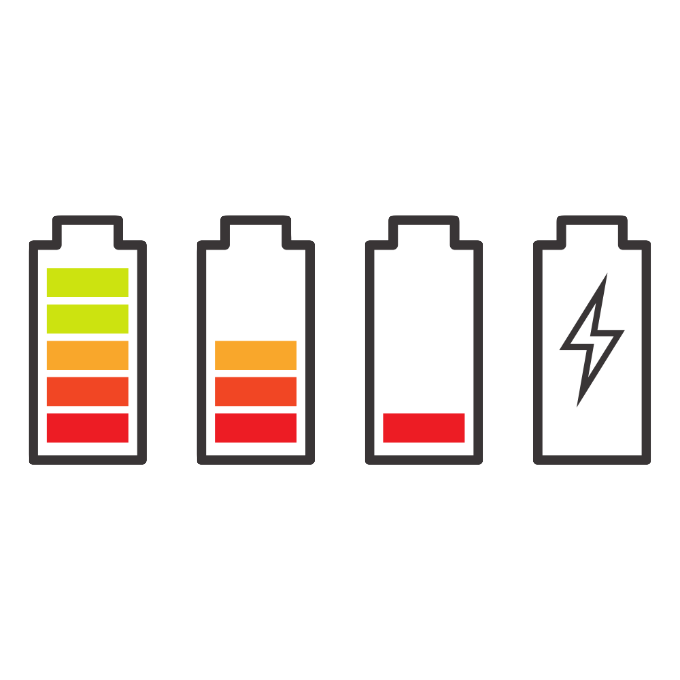
How much internal load the nervous system can hold without becoming overwhelmed, reactive, or depleted. HeartMath often describes capacity using the analogy of an inner battery. When the battery is charged, we have access to clarity, patience, emotional flexibility, and choice. When drained, even small stressors can feel overwhelming. Coherence-building practices recharge the battery by reducing unnecessary energy drain and restoring balance.
Baseline
The state the nervous system naturally returns to when there is no immediate demand. Through consistent coherence practice, baselines can shift — so that regulation, clarity, and emotional balance become more accessible by default.
The Four Domains of Resilience
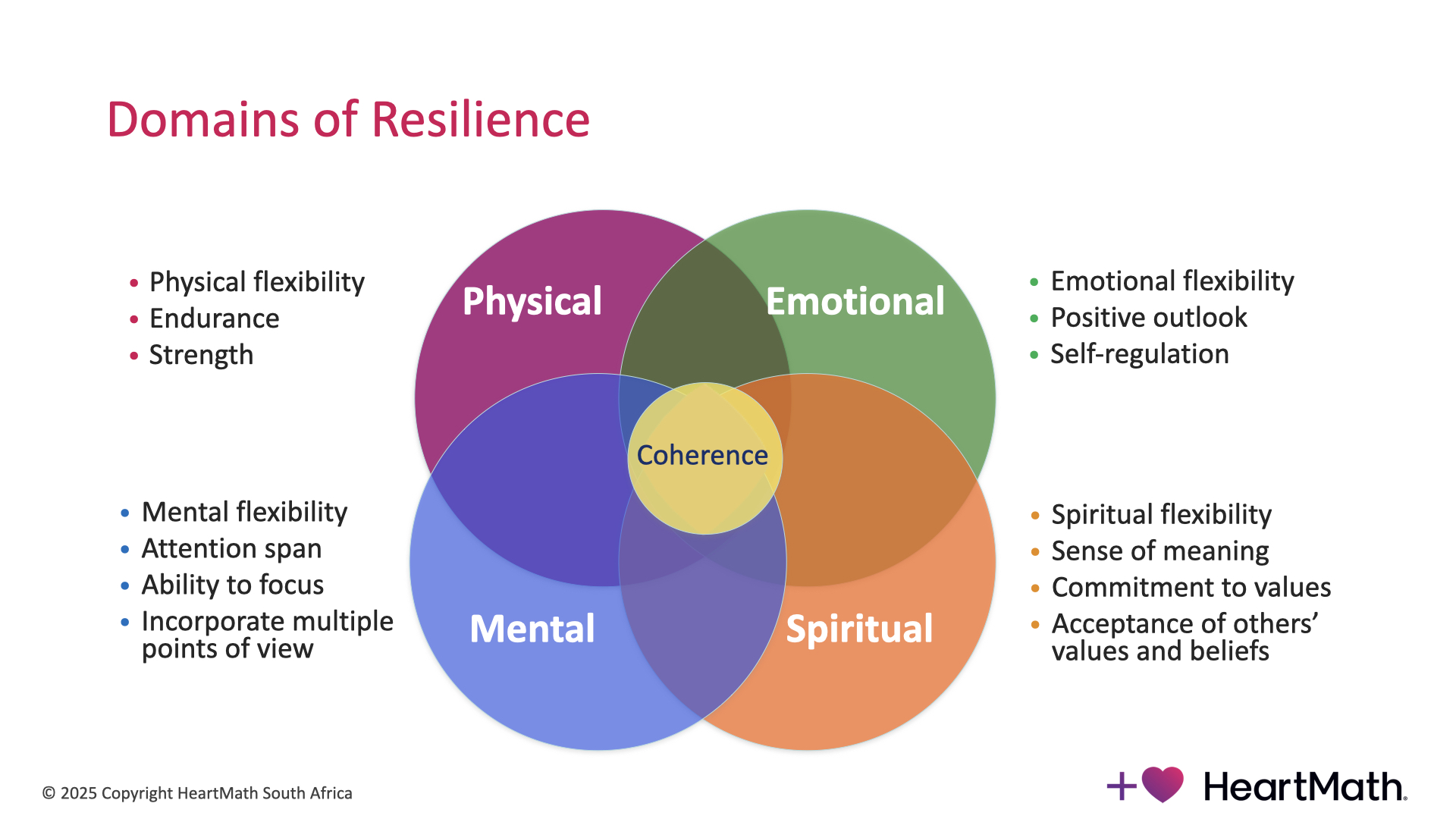
- Mental — attention, focus, perception, and interpretation. Incoherence here often shows up as mental noise, overthinking, worry or rumination.
- Physical — physiological regulation and energy balance. Regulating the breath is a key bridge between mind and body.
- Emotional — how emotions are experienced, regulated, and expressed. HeartMath works with recognising emotional states, reducing reactivity, and activating renewing heart feelings.
- Spiritual — living in alignment with one's values and inner truth, maintaining flexibility, and experiencing meaning, purpose, and connection. In HeartMath, this also includes the relational field — how our inner state affects others, and how shared emotional environments are created.
Techniques at a Glance
- Heart-Focused Breathing™ — Shift attention to the heart, breathe slower and deeper, imagine breath flowing in and out of the heart area.
- Quick Coherence® — Heart-Focused Breathing + activate a renewing feeling (appreciation, care, ease).
- Heart Lock-In® — Sustained Quick Coherence for 5–20 minutes to build baseline capacity.
- Freeze Frame® — Acknowledge → Coherence → Renewing feeling → Intuitive question → Test capacity.
- Attitude Breathing™ — Notice draining attitude → Heart focus → Ask for more beneficial attitude → Feel it.
- Inner-Ease™ — Inhabit ease as a sustained background state, not just a technique.
- Coherent Communication — Shift into coherence → Listen for the essence → Confirm mutual understanding.
- Heart Mapping® — Mind Map (off-load) → Coherence → Heart Map (listen for what matters most).
Science of the Heart
Reference Resource
Throughout this training, the emphasis has been on experience first. This page is here for a different purpose: to offer a scientific reference point for those moments when understanding matters. Science of the Heart, Volume 2 is HeartMath Institute's most comprehensive research publication — exploring heart–brain communication, autonomic nervous system regulation, HRV and coherence, emotional self-regulation, and psychophysiological resilience.
What this resource is not
This ebook is not required reading to practise or coach with HeartMath effectively. You do not need to memorise the science or explain the research to clients. Experience always comes first. When people feel the difference in their own system, the science becomes supportive — not persuasive. Think of it as a reference library, not a manual.
Conversations with Coaches
The practice begins.
This resource picks up where the training leaves off — written for coaches who have done the work and are now asking the real questions about what it actually looks like to coach with HeartMath in the world.
What it addresses
- The subtle differences between each HeartMath technique — when to use them and why
- A practical coaching structure for using HeartMath in real live sessions, and the psychology behind it
- How much information to give a client, and what science to teach them
- How many sessions to offer, what to do in each one, and what to charge
- How to build your coaching practice — who your clients are and how to find them
- Real-life coaching stories, examples, and a supervisory case study
- Coaching contracts and agreement templates to download and use
Pro Tips from someone who has been working with HeartMath since 2012
Alan Strydom draws on over a decade of coaching experience to address the questions that don't get answered in a certification training — the ones that only arise when you're sitting across from a real client.
Your Access Code
Use this code to access Conversations with Coaches. You'll be prompted to enter it when you open the link.
coach+heartmath
Notes and reflections as you work through the book.
Additional Resources
Reference Library
HeartMath Brain Fitness Program
Explores the critical relationship between emotions and the brain, how to harness neuroplasticity, and how coherence promotes optimal cognitive performance.
↓ Download (PDF)The Central Role of the Heart
Research on how the heart plays a central role in positive emotions such as care, appreciation, compassion, and love — and how coherence supports a repatterning of stress responses.
↓ Download (PDF)The Coherent Heart
An in-depth exploration of heart–brain interactions, rhythmic patterns in the nervous and hormonal systems, and a typology of psychophysiological states based on heart rhythm patterns.
↓ Download (PDF)The Hidden Power of the Heart
A journey of self-discovery grounded in emerging science, exploring deeper dimensions of awareness and intuition.
↓ Download (PDF)The HeartMath Solution
The foundational book explaining the connection between heart and mind and how coherence techniques support emotional regulation, resilience, and well-being.
↓ Download (PDF)The Intuitive Heart
Explores intuition as a natural human capacity, supported by scientific research into physiological and cognitive processes.
↓ Download (PDF)The Science of Interconnectivity
Explores the deeply interconnected system linking human beings and planetary field dynamics, including research on geomagnetic influences and collective coherence.
↓ Download (PDF)Next Steps & Certification
Final Integration & Certification Request
Integrating What You've Learned
This training was never meant to end with content. It was designed to change how you coach — how you pace conversations, recognise capacity, and hold space for regulation and insight to emerge. What comes next is not about adding more techniques. It's about practising the coaching stance you've been cultivating.
1. Practise the Coaching Model
Before moving toward certification, apply the coaching model in real conversations — not perfectly, not performatively, but simply, honestly, and with presence. Over the coming weeks: work with at least two volunteer clients, support each person through a minimum of three coaching sessions, and focus on regulation before insight, pacing based on capacity, and facilitating experience rather than explanation.
2. Reflect as You Go
As you coach, notice: where you feel settled — and where you tighten; when insight arrives naturally — and when it doesn't; how often regulation changes the conversation without words. These reflections will inform your final check-in with Alan.
3. Request Your Certification
When you feel ready — after completing your practice sessions — you're invited to request a final mentoring conversation. This is a relational check-in: to review your experience, clarify remaining questions, and sense readiness together. Certification is not about mastery — it's about integrity of application.
4. Ongoing Mentoring & Support
Many coaches continue with mentoring after certification — refining their coaching stance, navigating complex client situations, and deepening their practice. Think of mentoring as a place to stay coherent as a coach, not a place to be corrected.
Book a Mentoring Session →5. Continued Practice — For You
Your own coherence practice remains foundational. Return to Heart-Focused Breathing regularly, use Quick Coherence for preparation and recovery, and allow Heart Lock-In as a steady resource. The more coherence becomes embodied, the less you need to "do" in session.
Getting Clear — For You
For some coaches, the next question is about integration into life and work — clarifying your voice, your role, and how to engage clients without self-betrayal.
→ Getting Clear ProgrammeHeartMath coaching is not about getting it right — it's about staying regulated, trusting timing, and letting coherence lead. If you are practising from that place, you are already doing this.